

A Contemporary Mahākāvya and the Art of Poetic Restraint
Author | R. S. Hariharan | Assistant Prof | Jain University, Bengaluru
Classical Sanskrit poetry is often admired for its abundance; its luxuriant metaphors, its layered emotions, its seemingly inexhaustible descriptive energy. Yet beneath this richness lies a subtle discipline: a refined sense of what deserves description and what does not. One of the clearest expressions of this discipline appears in a traditional poetic framework known as aṣṭādaśavarṇana – the eighteen descriptive themes associated with the Sanskrit mahākāvya, or epic poem.
These eighteen “varṇanas” include time-honoured poetic terrains: cities and seasons, mountains and oceans, the sun and the moon, journeys and battles, love in union and separation, royal counsel and diplomatic missions, festivals, gardens, weddings, and more. Classical treatises such as Daṇḍin’s Kāvyādarśa enumerate them not as compulsory ingredients, but as a shared aesthetic vocabulary; a repertoire through which poets shape narrative, mood, and meaning.
Crucially, Sanskrit poetics has never insisted that all eighteen must appear in every epic. What it demands instead is aucitya – propriety, relevance, inner necessity. A description, however beautiful, has value only if it serves the life of the poem.
This principle finds a striking modern expression in Mathurābhyudaya, an unpublished Sanskrit mahākāvya by the contemporary poet Shankar Rajaraman. Centered on Kṛṣṇa’s journey from the pastoral world of Gokula to the politically charged city of Mathurā and culminating in the slaying of the tyrant Kaṁsa; the poem offers a compelling demonstration of how classical conventions continue to breathe, adapt, and evolve.
Tradition as Choice, Not Checklist
Descriptions associated with leisure and domestic celebration: garden revels, water sports, love festivals, weddings, the birth of princes – are largely absent. This is not neglect; it is deliberate restraint. The poem is not concerned with romantic fulfilment or dynastic continuity. Its emotional core lies elsewhere: in transition, tension, ethical urgency, and inner conflict.
What remains are those varṇanas that serve the poem’s deeper movement: the city as a site of transformation, the journey as psychological passage, the seasons as emotional barometers, intoxication as moral decay, counsel as political delusion, separation as unspoken ache, and battle as inevitable resolution.
In this sense, Mathurābhyudaya does not merely follow the aṣṭādaśavarṇana tradition, it interprets it.
The City as Threshold
अथ चलति रथे विहाय पल्लीरभिनगरि क्षितिरन्यथेव जाता ।
नवतरुणवयोविलासलक्ष्मीविघटितमौग्ध्यगुणा वधूटिकेव ॥
atha calati rathe vihāya pallīrabhinagari kṣitiranyatheva jātā ।
navataruṇavayovilāsalakṣmīvighaṭitamaugdhyaguṇā vadhūṭikeva ॥
Then, as the chariot moved, leaving the villages behind and approaching the city, the landscape gradually changed; like a young maiden whose fresh youthful beauty has blossomed while her childlike innocence has faded away.
॥3.11॥
Here, the city becomes a threshold: between innocence and confrontation, intimacy and power, familiarity and destiny. Gold ornaments replace lotus fibres; towering buildings eclipse open fields. The external landscape registers an inner change.
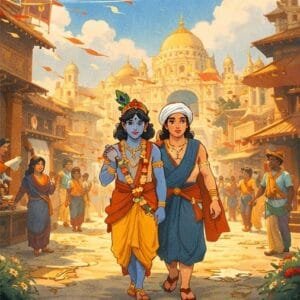
Kr̥ṣṇa and Balarāma entering the city of Mathurā
Significantly, the city is perceived differently by Kṛṣṇa and Balarāma, revealing their contrasting temperaments – one contemplative and inward, the other direct and observational. The city thus becomes not merely a setting, but a psychological lens.
Nature That Feels
Autumn fields droop as Kṛṣṇa departs from Gokula, as though unable to bear the agitation of his mind. When he later enters Mathurā with Balarāma, he is likened to spring moving through the city—a benevolent force suggestive of renewal and balance, though the season itself has not changed. Summer heat, in turn, becomes the metaphor through which Kṛṣṇa’s touch transforms Kubjā, melting her deformity into grace as sunlight dissolves lingering frost.
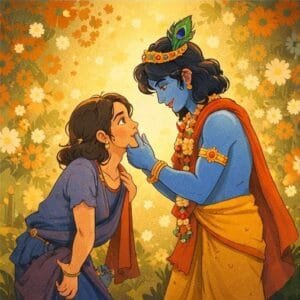
Krishna dissolving Kubjā’s deformity
The moon and sun are not passive luminaries. The moon reveals moral clarity, standing for sattva amid darkness; the sun measures time, duty, and inevitability, even as Kṛṣṇa’s heart lingers elsewhere. At moments, solar imagery slips into philosophical reflection, invoking Vedāntic ideas of presence without visibility.
पूषा प्रकाशिताशेषपदार्थप्रकरोऽपि सन् ।
अस्थाद्व्योम्नि दुरालोको हृदीव परमेश्वरः ॥
pūṣā prakāśitāśeṣapadārthaprakaro’pi san ।
asthādvyomni durāloko hṛdīva parameśvaraḥ ॥
Although the sun has illuminated the entire multitude of objects, he has stood in the sky difficult to behold, just as the Supreme Lord dwells in the heart.
॥1.38॥
These descriptions do not slow the narrative, they deepen it.
Darkness at Court
पूर्यमाणं प्रतिमुहुर्मधुना तस्य भाजनम् ।
बभूव न मनाग्रिक्तं खलस्येव मनोंऽहसा ॥
pūryamāṇaṃ pratimuhurmadhunā tasya bhājanam ।
babhūva na manāgriktaṃ khalasyeva manoṃ’hasā ॥
His cup, being filled repeatedly with wine, never became empty, just as the mind of the wicked is never free from sin.
॥6.2॥
Counsel does not enter him, only liquor does. Intoxication becomes the outward sign of an inward collapse. This moral inversion reaches its height in the varṇana of ministerial counsel. Kaṁsa’s advisors are not wise statesmen; they are personifications of the ariṣaḍvarga: desire, anger, delusion, greed, envy, pride. Each offers advice that leads him further from clarity. Even his queens’ counsel oscillates between misplaced reassurance and desperate strategizing.
Politics here is not pragmatic, it is tragically self-deceptive.
Journey and Battle
पुरो नीडद्रुमादभ्रं पतन्त्यै पक्षिपङ्क्तये ।
आशंसत स निर्विघ्नां प्रत्यागतिमहःक्षये ॥
puro nīḍadrumādabhraṃ patantyai pakṣipaṅktaye ।
āśaṃsata sa nirvighnāṃ pratyāgatimahaḥkṣaye ॥
Seeing a flock of birds lift from their nesting-tree and wing toward the sky, he wished them an unobstructed return at evening’s end.
॥1.16॥
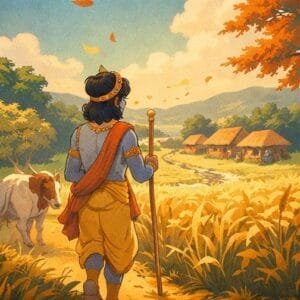
Kr̥ṣṇa observing the flock of birds
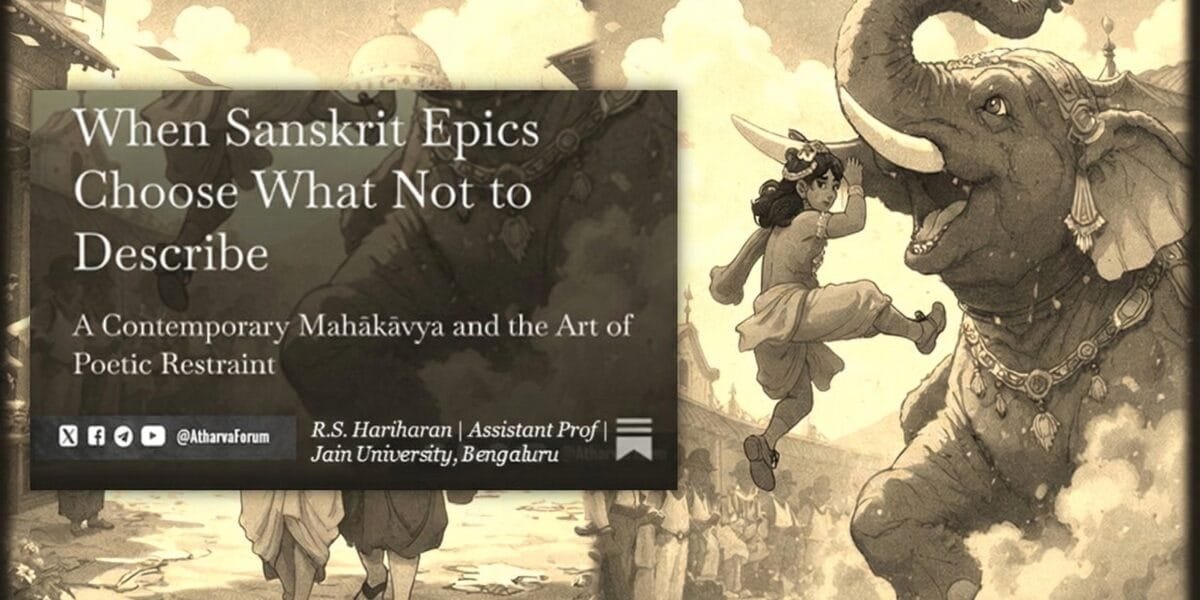
By the time battle arrives, it does not feel abrupt. The encounter with Kuvalayāpīḍa, the elephant, is framed in cosmic imagery – lotus feet seized, divine crowns gleaming, clouds and lightning evoked. Violence is swift, decisive, almost elemental.
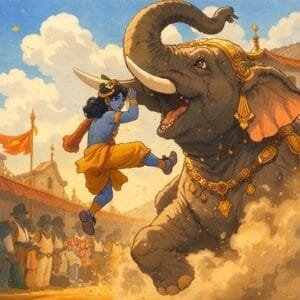
Kuvalayāpīḍa’s encounter with Kr̥ṣṇa
Battle is not a spectacle here; it is resolution.
A Living Poetic Tradition
In choosing which descriptions to include and which to leave aside, Shankar Rajaraman shows that contemporary Sanskrit poetry is neither nostalgic nor imitative. It is conscious, selective, and alive.
The epic does not ask how much can be described.
It asks: what must be described?
That question, perhaps, is the true inheritance of Sanskrit poetics.