
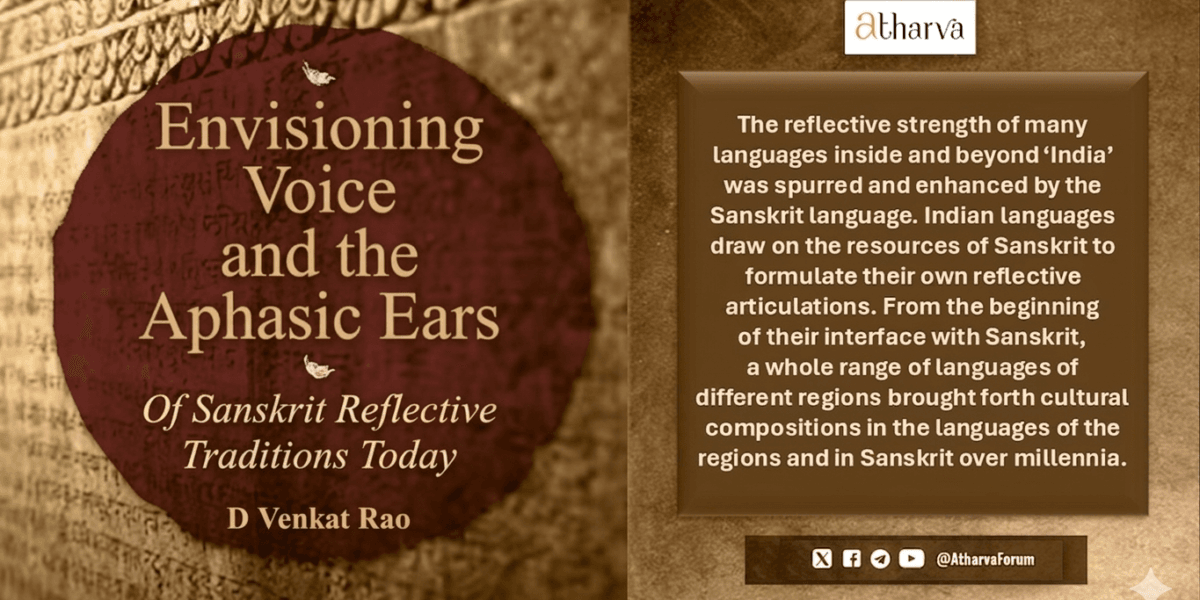

This is a follow-up to an earlier article on Prof. D Venkat Rao’s book ‘Envisioning Voice and the Aphasic Ears: Of Sanskrit Reflective Traditions Today’ (2025). Unlike the previous one which was primarily a transcript of a conversation with Prof. Rao on his book, this article will touch upon my own reflections as a reader.
In this article, we will delve deep into various key concerns and concepts related to Sanskrit/Indian cultural memory, Humanities education, Pagan pasts and their interface with Semitic cultures. We will also touch upon Jatis and the relationship between Jatis and the twin currents of Shruti and Smriti. The purpose of writing this is to bring forth attention to these important concepts and foster a culture of inquiry into understanding Sanskrit reflective traditions and other related cultural continuities.
Millennia old cultural formations in the sub-continent seem to defy expectations of seeing culture of a given region as a homogenous uniform whole. There is a kaleidoscopic quality to how cultural memory manifested here. By giving an example of both the time and space breadth of this cultural spread, Prof. Rao asks this question:
“Given the heterogeneity of cultural formations of India from Gandhara to Brahmaputra, from Harappa to Sangam, can we assume that Sanskrit/Indian cultural memory is a homogenous entity? If Jatis as bio-cultural formations played the role of the guardians of memory, can one assume that Indian memory is a chaos of incoherent diversity? Or, is there a possibility of discovering any shared aspects of cultural memory across divergent Jatis proliferated across extended periods of time and space?”
There seem to be multiple interpretations at work today on this matter. Some tend to lean towards the need to rationalise some of this diversity and homogenize it towards a Sanskrit primary cultural memory and experience formulation. Those who contest this tend to bring up the kaleidoscopic diversity to argue that this cultural memory cannot be homogenized and there is nothing that explains or connects these incoherent diversities. They do not like to talk about the shared aspects between these diversities and like to see them as standalone entities. Prof. Rao implores us to study the possibility of discovering shared aspects of these cultural memories. Jatis are seen as guardians of cultural memory in this formulation. Our attention is drawn to understand the distinct nature of Sanskrit traditions, its intimations and interfaces with hospitable hosts and its traversals over centuries.
Diversity of various forms of cultural memory and languages is a hallmark of Sanskrit intimated traditions and by corollary Indian/Bharatiya cultural memory as well. Prof. Rao says the following elaborating on this aspect:
“Given the fact that cultural forms such as Itihaasa, Purana, Kavya and Katha (stories) have spread across the entire subcontinent and beyond in Sanskrit and Bhasha literary cultures on the one hand and visual cultures over millenia over the other, it should be possible to track and grapple with the enduring and transformative aspects of shared articulations of memory deeply intimated by the work of Sanskrit traditions”
Elsewhere in the book, Prof. Rao remarks that Hindus are a preposterously totalized but wholly untotalizable ‘community’. There seems to be an inherent expectation from many commentators today that a community needs to have a certain sense of uniformity in its culture with a lot of sameness both when we consider a religious community and also when a nation itself is seen as a community.
Sanskrit/Indian cultural memory seems to defy this frame. Seeing Sanskrit/Indian cultural memory as a ‘homogeneous entity’ vs ‘as a chaos of incoherent diversity’ vs ‘as shared articulations of memory deeply intimated by the work of Sanskrit traditions’ is indeed an interesting framing for the possibilities here. It does capture most of the narrative currents around describing Indian culture today.
‘Shared articulations of memory deeply intimated by the work of Sanskrit traditions’ is a powerful explanation to explain coherence in our otherwise chaotic diversity. However, this phenomenon of Sanskrit intimations should perhaps be contrasted from sociological theories like M.N. Srinivas’s Sanskritization. There is a lot more of erasure and aspirational hierarchy involved in that notion of Sanskritization as compared to this description of
‘Shared articulations of memory deeply intimated by the work of Sanskrit traditions’.
At the same time, as a thought experiment, if we were to imagine a state when these deep intimations by the work of Sanskrit traditions are absent perhaps, we would then be closer to being a chaos of incoherent diversity. Can we then theorize that the work of these Sanskrit traditions is pivotal for the cultural experience as it stood across millennia and what goes by as ‘Indian’ culture today? Building a cohesive understanding of the relationship between Sanskrit traditions and others continues to be crucial to this day. Particularly so, in today’s heavily politicized environment.
Prof. Rao emphasizes that languages and cultures of ‘India’ began to get systematically disoriented with the implantation of European educational models spread across in discourses, languages and institutions. Addressing this would need a fundamental reorientation of teaching and inquiry in the humanities he says:
“One possible way of addressing this catatonic existence is to strive and fundamentally reorient the teaching and inquiry in the humanities. After all, it is the humanities disciplines (literature, philosophy) that functioned as engines of European culture (the emblem of science, civilization and progress). The reorientation must primarily focus on learning to sense the reflective resources of languages one is born into or exposed to. This requires dedicated learning and training in the uses of Indian languages honed over centuries and millennia, against the institutionalized religious background (of the invasive heritages)”
It would be worthwhile to study if all societies that experienced colonialism face a disorientation of this scale and scope like we do in India. Our memories continue to linger and persist in various forms to this day. Albeit not as lively as they were in the past. But they do persist. It is perhaps this unique persistence of so many forms of cultural memories that differentiates the Indian experience from other colonised nations. We lead a catatonic existence where neither can we adapt to European culture in toto nor can we reconnect to our pre-Colonial moorings as we are too distanced from our inheritances and blinded in ignorance. The availability of cultural resources also opens up several possibilities for reorientation of humanities in the Indian context. However, there might be shared learnings that one can benefit from by studying if and how any reorientation of humanities is happening in any of the other regions which experienced colonisation of some form like Africa and to a lesser extent regions like China and Japan.
Specifically in the Indian context, it is also interesting to note the contrast between the Euro-colonial epoch and the long period of Islamic invasions and the continued interface with Islam across centuries. While there have been significant disruptions and negative impacts to cultural continuities due to the Islamic epoch, it doesn’t seem to have affected education, science and technology and sense of self as much as the Euro-colonial epoch. Particularly on the humanities question there doesn’t seem to have been any cogent equivalent for what hit us in the Euro-colonial epoch. This seems to be a very distinct post enlightenment Europe’s redefinition and reorientation of humanities that has been foisted on all colonial societies.
In this book, Prof. Rao writes about the interface between Sanskrit and what Sanskrit called the Mleccha. This distinction is of particular importance to our times today. Firstly Sanskrit reflective traditions need to be understood and the distinction between Sanskrit’s reflective integrity as a language needs to be contrasted with other European languages like English in this context. Secondly the interface between Sanskrit and other languages that were hospitable to Sanskrit need to be understood thoroughly. More so in the Indian context of millennia old interfaces between many Bhasha-s of India and Sanskrit. Thirdly, we need to study this distinction being made by this categorisation of Mleccha.
On the distinct nature of Sanskrit traditions Prof. Rao writes as follows:
“This book, Envisioning Voice and the Aphasic Ears: Of Sanskrit Reflective Traditions, attempts to delineate the formations of ‘Sanskrit’ – a nameless utterance for nearly two millennia. Sanskrit continues to be an utterance on the drift without a definitive origin and an ultimate destination. Yet it’s adestinal drift seems to move with an impulse which nurtures its integrity. The reflective integrity of Sanskrit unfolds in intimating an ethos and idiom in all its formations and traversals. The throb of its pulsating intimation can be sensed in all formations of language and cultural forms in all the locations that were and continue to be hospitable to Sanskrit”
The nameless, destination-less, beginningless, endless millennia-long journey of Sanskrit is indeed fascinating to study. Sanskrit intimations can be seen across several languages and cultural forms across the world in this journey. Particularly so in the Indian subcontinent. What is interesting in these intimations is the lack of any annihilating impulse towards the other. Sanskrit never carried any aspiration to be a national language of a region at the expense of prevailing linguistic diversities. It continued its journey while nurturing these intimations to whoever was hospitable. This journey of Sanskrit is very different when compared with that of other languages, particularly those languages that came with their own religious or theological baggage in the Semitic and European context.
On Sanskrit and Mleccha interface, Prof. Rao writes
“The other risky attempt of this book is to unravel the interface between Sanskrit and what Sanskrit called the Mlechcha, those whose speech is unclear or unintelligible. That is, the ‘ear of the other’ fails to hear the envisioning voice of the utterance. To be sure, and this is worked out in the book, there is barely any interface between Sanskrit and the Mlechcha cultural forms and formations; this is so despite the fact that Sanskrit and the Mlechha coexisted over millennia in all the traversals of Sanskrit”
“Yet, today all over the world wherever universities exist, all the prevailing conceptual taxonomies and knowledge systems are determined by a dominant Mlechcha religious or theological heritage. Perhaps it is the overwhelming command of this heritage which seems to obscure the palpable traces of the rizomic relations between Sanskrit and the sources of the Mleccha”
One of the reasons for the dominance of Mleccha religious or theological heritage in university education and education in general today, specifically in the Indian context, is that there is a tacit agreement that this heritage is supposed to be the harbinger of hitherto unknown levels of material prosperity and standard of living. Embracing this heritage is key for progressing on modern science and technology we are told. If ‘we’ have to ‘develop’ then ‘we’ need to understand ‘their’ knowledge systems that produced the science and technology that ‘we’ lacked due to which ‘we’ fell behind. This is a school of thought as well that finds some credence today. We should compete with ‘them’ and if possible, get ahead of them and win this race if we care for our own sovereignty and sustenance as a people. This is the dominant narrative on this matter.
Moving away from Mleccha religious or theological heritage on matters of education is also seen as a route towards poverty or lesser material prosperity (i.e. ‘We’ve been defeated in the past because of our exclusivity or reliance on our own heritage or because we weren’t open enough. We shouldn’t fall behind once again so on).
Hence, any talk of Sanskrit traditions is also seen as a nostalgia trip. There is a sense of clinging onto a bygone past and some even see this as a lost cause. ‘Let us not go back to the penury of pre-Colonial times’ is the dominant sentiment.
To progress further in this journey of unravelling the Mleccha religious or theological heritage on knowledge systems that dominate our universities today we need to address these concerns above. This has to go beyond reasons based purely on inheritance, sentimentality and heritage i.e. identifying ourselves as non-Mleccha hence emphasizing the need to study what is truly ours. That alone may not be sufficient for reasons mentioned above of seeing ourselves as a defeated people post-colonial epoch.
The other challenge that is in front of us is the problem of ‘distanced’ inheritors. Prof. Rao refers to students in the current day Indian university classrooms as ‘distanced’ inheritors. While that is true, it is also equally true that a lot of the faculty members i.e. those tasked with teaching the students themselves may be distanced inheritors with little appreciation of the Mleccha religious or theological heritage baggage in university education and on their own cultural inheritance(s). Addressing this issue amongst teachers is a significant challenge too. And perhaps a much more formidable one as compared to addressing this problem of being distanced from inheritance(s) amongst students.
The impact of the euro-colonial epoch can be distinctly felt in the conception of History as a discipline in post-colonial India. Prof. Rao writes as follows on this topic:
“As is well known Indology’s incessant critiques of Indian culture centre on the question of history. Indian cultural formations are categorically denied any sense of history and any discourse of history.
Mnemocultures, lacking literacy, are by definition said to lack any sense of history. No contemporary scholar advanced any serious inquiry into the alleged cultural universality of the discourse of history. Certain cultures may evince indifference towards a historical-referential discourse and may not cultivate such modes of recounting the events of the past; they may not produce tracts about the social. But can they also be said to lack a sense of the past? Should the sense of the past be articulated only in such objectivizing documentary discourse?”
This tussle between history and sense of past is acutely felt in the case of India. It needs to be seen how history academia scholars in India are grappling with the implications of this and how this awareness materially transforms the discourse on how we see our past within Indian academia. While there are sporadic attempts being done to grapple with the import of this cultural universality of the discourse of history, we also see this play out in many other categories as well. Similar to ‘History vs Sense of past’ contrast, Prof. Rao also refers to how kala is not to be seen as Art particularly in reference to works of Ananda Coomaraswamy. As Prof. Rao says there is an inquiry to be done here on how the theologico-metaphysical frame derived from European cultural experience gets imposed on Sanskrit traditions of mnemopraxial (memory and practice based) creations and reflections in this question of kala vs Art. This book opens up such pathways and implores us to indulge in many such investigations.
Prof. Rao also writes about how these cultural memories in question are lively archives as opposed to being mere externalized memories. These are living currents of embodied memory where the body becomes the vehicle for the cultural memory. Reinvigorating these memories and providing the right conditions for these lively forms to persist is quite some challenge in our times today. While there is some work happening in ethnographic/folkloristic disciplines, more often than not they end up in freezing and museumising these lively archives and reducing them to externalized preservative systems Prof. Rao mentions. The task of reinvigoration is particularly difficult in the current climate of distanced inheritors where the inheritors suffer either from forgotten memories or ruptured memories and in some cases, we also have inheritors who want to actively distance themselves from their inheritance and avoid association with these memories from their past.
There is also the question of limitations of the university structures. Can institutional transmission mechanisms do what was done previously by familial or community inheritances? This is a question we need to grapple with. These bio-cultural inheritances by nature were selective inheritances. They were not necessarily in the open-for-all democratic structures that have come to define our public university setups today. Can the institutional or public curriculum led collective inheritance model ensure these transmissions flourish in the same way as before? That is something that needs to be explored. Elsewhere in the book Prof. Rao differentiates between the role of traditional parampara continuities and what universities or educational institutions need to do. Perhaps that is a more realistic way forward. Universities should focus on correcting the dristhi dosha and reorienting us away from the Mleccha lens and not necessarily take on the mantle of furthering all the parampara continuities. It is far beyond their capacity to do so.
Prof. Rao also has some scathing criticism on how Western hegemony continues to dominate the Indian university context. He specifically talks about the plight of non-Abrahamic cultures of the world as follows:
“For centuries cultures have been studied and compared only on the basis of the dominant cultural framework of the West. Neither the discourses nor the institution of the university in the Indian context unravelled this hegemony on the basis of Indian cultural experience. The Indian cultural experience has been put on the table for the lab-experiments of European discourses for generations. The non-Abrahamic cultures of the world have barely drawn on their cultural resources to generate a reflective alternative to the hegemonic Western theological-cultural framework”
“Today the entire conceptual grid of the humanities – from the notion of the human and the category of the humanities to those of the literary, art, philosophy, aesthetics, culture, science, nation, religion, comparison, university, language and translation – derives quintessentially from European cultural thought; a testimony to the power of the European implant. Such a grid continues to determine our conceptions and relations in receiving and responding to contexts”
It is unclear how much the teaching class of Indian academia and the policy makers of today’s India understand the issue at hand. While we are in a better position compared to several other non-Abrahamic cultures of the world in the sense that we aren’t wiped out or converted enmasse yet, the sheer diversity of our resources and magnitude of challenge makes the reorientation and generation of alternatives complex and time-taking in the Indian context. Can the kind of heterogeneity and diversity that is present in the ‘Indian’ context even be handled by the university as a construct? This is a question we need to ponder upon.
How is the ‘Indian’ conception of a university going to be different from the ‘European-Abrahamic’ conception of university? This is another question we need to answer to ourselves if we are to invest in alternatives to the hegemonic Western theological-cultural framework.
Another seminal contribution of Prof. Rao through this book are his deep insights on the interfaces between Semitic cultures (Judaism, Islam, Christianity) and two kinds of Pagan cultures: Pre-European pagans and non-European pagans. This is an area that gets very little attention in Humanities academia in India and within what goes by as popular culture as well.
Prof. Rao writes:
“If the mnemocultural bardic ethos of the Greeks was displaced and disparaged by the philosopher, the Arab bardic culture seems to have met the same fate from the (religious) prophet.”
“Quran claims superiority over the bardic heritage..”
“.. so-called pagans either disappear into silence or impelled to be partisans in alien fraternal wars of expropriation (Jews, Catholics, Protestants so on)”
Many times it feels like a lot of Indian cultural reform battles from the early 19th century colonial era are essentially a replay of European reformation era protestant and catholic battles and Semitic vs non-Semitic frame challenges. What is fascinating is how a lot of these attitudes were carried forward by the natives knowingly or unknowingly long after the colonizers left. One of the explanations for this enduring phenomenon perhaps lies in the above formulation of pagans who are impelled to be partisans in alien fraternal wars. Colonised pagans seem to take positions in wars that are not even theirs to begin with and end up mimicking alien fraternal factions within the Abrahamic religions. There is an expropriation of the mind that is at work here.
Elsewhere, Prof. Rao writes about mnemocultural (i.e. cultures of memory) pasts of Pagan antiquity and their denigration and liquidation with ascendancy of Abrahamic monotheisms. These are topics that are seldom studied in sufficient detail within Indian academia. Understanding this journey of bardic cultures is of great importance if one were to understand the evolution and eventual hegemony of History as a discipline and the hegemony of European humanities in general. Prof S N Balagangadhara also writes about these Bardic traditions in his article What do Indians Need: A History or the Past–S.N.Balagangadhara – All Roads Lead to Jerusalem . A thorough study of the interface of pre-European pagans and non-European pagans with Abrahamic cultures is extremely helpful in understanding the experience of the past couple of centuries of colonial India and in conceptualising a response and working towards the formulation of an alternative.
In the absence of this understanding, we might end up in a tragicomic situation where we seek to reorient our past towards history and end up in historicizing and chronologizing all our stories about our deities and our traditions. This has started happening already in the past few decades in India. Particularly so in the popular history sphere. Rationalizing of stories and episodes in Itihasa-s, Purana-s, Vedas to make them sound less supernatural and more believable and historicizing and chronologizing them all to attribute legitimacy for them has been rampant. We seem to have jumped into the arena without even understanding if this battle would fundamentally transform the nature of who we are and our own sense of the past. Prof. Rao’s writing on this topic of history vs sense of past is important in this context.
Our university structures in India today are also structurally tied up to this European heritage today as Prof. Rao mentions here:
“Neither literature nor the University as it functions today is free from anthropo-theological structure configured in the Kantian system”
“The German-Judeo-Protestant-Christian thought advances itself as the ultimate leader of planetary existence and thought”
The treatment meted out to the pre-European pagans and non-European pagan cultures is also markedly different as Prof. Rao writes:
“The pre-European pagan, for example, gets appropriated and assimilated into the spirit of inquiry and science .. In contrast, the non-European pagan is forever coded as empirical and absorbed into the regional sciences of anthropology and history”
These constructs need to be carefully studied by academicians and education policy makers today to untangle ourselves from this web. This is a challenging task on both sides of the framing i.e. the European side and the pagan side. This is also a challenge for the European/Western side of the house as Prof. Rao writes:
Can Europe show hospitality which it denied the pagan over millennia – to such hetero-genos of mnemopraxial being beyond its cherished Semitic-Abrahamic heritage? How can the non-European pagan space him/himself with/in a culture that gathers only fraternal semblables and assimilates aliens into a similitudinal assembly even if it circulates itself as a democracy?
This is a very complex entanglement that post-colonial societies have gotten themselves into. On the ‘pagan’ side of the house unravelling this will need a deep study and engagement with their own ‘pagan’ traditions and understand their interface with the Semitic-Abrahamic heritage. At the same time the European mind also needs to figure out its complex history with the pagan others and come to terms with the task of recalibrating its relationship with them if academia needs to abide by the democratic credo.
Another distinct problem that non-Abrahamic cultures (pre-European pagan and non-European pagan both) pose to the university education system as it is exists today is their reliance on what Prof. Rao calls alithic forms of memory retention as opposed to lithic forms of memory retention. Lithic here refers to various forms of external memory like inscriptional and textual forms of media retention etc. Alithic memory refers to the kinds of memory where transmission relies on human or lively forms like oral memory, bodily gestural communication, performative art forms and so on. European university structures seem to be more tuned towards lithic memory and this further complicates the process of understanding the non-European non-Abrahamic cultural memories.
Prof. Rao also pays special attention to the phenomenon of Jati in this book like he has done in his past works. There is an attempt to define Indian culture using these concepts of Jati, Shruti and Smriti which is a very astute formulation and would be useful to the broader public discourse on Indian culture.
Prof. Rao writes:
“Almost every Jati and Jan-Jati of India has, directly or through detours, embraced, transformed and enhanced the Smriti traditions beyond measure. If there is such a complex which can be called ‘Indian culture’ it is entirely the result of intense and persistent responsive receptions across the twin currents of Shruti and Smriti, on the one hand, and that of the Jatis, on the other. All the extant and emerging mnemocultural forms of image, music, text and performance of India (and its relays) can be explored as the dynamic effects of such responsive receptions. The reflective and creative media of India, from oral to digital technics, are multiply woven in the mnemocultural milieu”
This interplay between Smriti traditions and Jatis and Jan-Jatis needs to be studied deeply to understand what ‘Indian culture’ means. Smriti traditions here is an expansive definition that encompasses various cultural forms such as Sutra, Shastra, Itihasa, Purana, Naatya, Silpa, Chitra, Kavya and so on. The phrase responsive receptions here is important to note. There is a creative impulse that is kindled here and this is what leads to the multitude of cultural formations in the Indian context. There is no impulse to homogenize and neither is there a genocidal impulse to annihilate any extant cultural forms. These are reflective and creative processes that rely on responsive receptions.
Hence, it is perhaps not incorrect to say that it is not possible to define Indian culture without accounting for the Jati and Jan-Jati responsive receptions to the twin currents of Shruti and Smriti. This is different from the textual understanding of Indian culture which usually restricts itself to textually frozen categories, content and chronologies.
Prof. Rao also distinguishes the Semitic religions from the Sanskrit traditions by saying that the interpretive violence of the semitic subsumes the non-Semitic/Pagan but Sanskrit traditions do not unleash invasive interpretive formations. This distinction between non-Semitic/Pagan, Sanskrit traditions and Semitic religions is seen repeatedly throughout the book. This is an important distinction to study thoroughly as it often happens today that these differences aren’t studied enough and all of these varied religions and traditions are clubbed together in one category called ‘Religion’. As a result of this the Semitic religions, Sanskrit (intimated) traditions and Pagan cultures all belong to one category called ‘Religion’ in the minds of many. There is also an implicit assumption that all of these share a lot of similar characteristics since they are all members of one category/group called ‘Religion’.
However, a sincere study of Sanskrit traditions and the journey of Sanskrit traditions through its intimations with the hospitable host traditions wherever it went, would reveal an incredible ability to live on with those that are unlike itself. The twin phenomena of intimations with the hospitable host and the cultivated indifference to those who are hostile to these intimations needs to be studied. In this context it is perhaps appropriate to see the interface of Sanskrit traditions with Mleccha also as non-subsuming or non-invasive. The idea is to cultivate a sense of distance and indifference from the Mleccha but there is no desire to convert or annihilate the Mleccha. This is very different from how the Semitic-non-Semitic distinction operated and how the fraternal feuds within the Semitic frame operated.
Given the contemporary demographic transformation in India and Indian sub-continent at large, it is important to also situate the relationship between Sanskrit traditions and Semitic religions today. ‘Tolerance’ of the semitic other in the context of ‘Indian’ culture becomes an important part of living together. This is also important in the context of Prof. Rao ’s suggestion that a reflective background of what is called ‘India’ will have to be sought from Samskruta Vaangmaya. Prof. Rao also refers to the suturing of the gap between Sanskrit and ‘India’. Given this context we should also ponder on how Indians who today associate themselves to Semitic religions like Islam and Christianity relate to this Samskruta Vaangmaya. The route to engage with them perhaps should rely on the Samskruta Vaangmaya connections to their lingering non-Semitic/pre-Semitic cultural memory.
Prof. Rao also writes about how polyvocal inheritances of the Sanskrit utterance can provide a path forward to respond to the paradigm of humanities at large.
“Biocultural formations of ‘India’ brought forth their heterogeneous performative reflective forms embodying such enlivening experience. It is precisely such enlivening experience that must help one to unravel the institutionalized domains of the humanities. In other words, one must explore the possibility of responding to the paradigm of humanities (philosophy, literature, university and science), chiselled out of Christian experience, from the receiving ends nurtured by the polyvocal inheritances of the Sanskrit utterance”
This path however is fraught with multiple challenges. Biocultural heterogeneous performative reflective forms may be ill-suited for a public curriculum model as there are too many inheritances and it might not be easy to democratize them all i.e. provide equal access to everyone for all inheritances. Also, it is an uphill battle to cultivate sensibilities so that everyone can appreciate everyone else’s inheritances in this vitiated educational environment of today. We might need to also grapple with scenarios where there are people who have lost memory of their inheritance or would like to pick and choose something else.
The impulse to co-exist with the ‘other’ albeit with some cultivated indifference is seen not just in Jatis but also on how differing viewpoints are dealt with in Darshanic debates. Confrontation via purvapaksha or otherwise in case of darshana-s is not aimed at some kind of conversion aimed at assimilating differences, but precisely in sustaining differential vantage points Prof. Rao writes. This is another aspect that distinguishes Sanskrit traditions from Semitic religions. This concept of sustaining differential vantage points without assimilating or converting is also a descriptor as much for Jatis not just darshana-s alone. This aspect of ‘Indian’ culture needs to be studied thoroughly as it seems to offer some path forward in a strife ridden world today.
It is this aspect of Indian culture that Prof. Rao elaborates further in multiple parts of the book. And this understanding of Indian culture has eluded many scholars and commentators for a long time now. This formulation offers some hope for a way out from the current chaos.
Prof. Rao writes:
“In this asymmetric relation between Samskruta and ‘India, what might appear to be a wholly counter-intuitive claim can be suggested. Despite the ethnicist configuration of Sanskrit as an entirely self-enclosed, ethno-centric, self-serving community – a patently European configuration – it is Sanskrit which can provide significant intimations for understanding of heterogeneous biocultural formations living together differently in variedly shared habitats”
Sanskrit today is understood by some as a homogenizing force. In political rhetoric it is portrayed as a threat. As something that is keen on erasing non-Sanskrit traditions or languages. However, this understanding of Sanskrit traditions is patently false and untrue. As Prof. Rao writes above Sanskrit traditions can indeed teach us lessons in living together differently. Sanskrit traditions traversed via these intimations without seeking to annihilate or convert or homogenize. However, these intimations have also developed a shared togetherness across languages, regions, jatis and jan-jatis over centuries. It is this cultural complex that makes up our understanding of India today.
Prof. Rao further writes on Jatis:
“Such understanding is deeply ingrained in the practices of liveable learning conceived in Sanskrit as modes of being of Jatis. Jati refers to a process of perpetual internal self-differentiation of what can be regarded as a unit (without unity); the unit in question can refer to the entire range of formations that existence brings forth (mountains, trees, animals, birds, colours, sounds, genres and – among them – the so-called humans). Jatis can never be totalized and homogenized. No one can count the number of Jatis – they are finitely limitless. Each Jati – with its persistent differentiation – brings forth cultural forms and modes of being that are distinctive of that particular biocultural or physical formation”
We need to comprehensively reorient our mainstream discourse to start seeing Jatis as guardians and vehicles of cultural memory and start appreciating these biocultural formations that indulged in deep intimations with Sanskrit traditions. To understand the expanse of Indian culture (and potentially other cultures that interfaced with Sanskrit traditions) one needs to perform a thorough study of these responsive reflections of Jatis and Bhashas to these intimations from Sanskrit traditions.
Elaborating further on this idea of culture in the Sanskrit/Indian context Prof. Rao writes:
“If there is something called culture in the Sanskrit/Indian context, it is entirely made possible by the assemblages of vidya-s, kala-s and anushtaana-s brought forth by these self-differentiating biocultural formations. Puranas and Itihaasa-s live on in the dynamically differentiated circuits of the biocultural formations. The ethos and idiom that the Sanskrit traditions unfolded and proliferated are responsively received and trans-formed by the Jatis. In other words, the colossal indefinite assemblages of Jatis, like all the foreign polities, peoples, and their languages, remained hospitable to the intimations articulated through the ethos and idiom of Sanskrit. One must also point out here that these heterogeneous complexes of Jatis lived on differently but shared aspects of an ethos and idiom and lived on without harbouring any genocidal impulses. No major Indian language can be said to have rejected hospitality to Sanskrit in the latter’s traversals”
Prof. Rao ’s seminal contribution to the humanities discourse in India lies in this formulation above. In our times today we do see some lip service for this cultural diversity in the Indian context. However, many a time the shared aspects of ethos and idiom alluded to above is denied any attention. The lack of any genocidal impulse is not acknowledged. Instead, Sanskrit is always seen with suspicion as if it harbours homogenizing and hegemonic tendencies. However, as highlighted above the Indian experience is far from this. Jatis and Bhasha-s flourished with their interface with Sanskrit during its traversals. The genius of Indian culture and Sanskrit traditions lie in these intimations with Jati-s Bhasha-s that led to the creation and flourishing of an insane variety of performative reflective renditions across several cultural forms. No major language felt threatened ever in these intimations with Sanskrit traditions. Those that were hospitable to it were further enriched and enlivened post this interface with Sanskrit. This is very different from how Semitic religions and associated languages traversed Europe before colonialism and after.
The question of jan-jatis, sometimes also called as tribes, is important to ponder in this aspect. There is also a tendency seen to construct tribal cultures and tribal languages as independent or free of Sanskrit (ethos and idiom) influence. Hence seen as more authentic by some! They are portrayed as an ‘untouched peoples’ ‘indigenous’ ‘other’ to Sanskrit and Sanskritised languages/cultures. We also see the usage of terms like Adivasis, Moolanivasi-s so on. The interfaces and relationship between Sanskrit traditions and these Jan-Jati traditions need to be explored in some detail too to complete the understanding of Indian culture as it stands today.
Any exploration on these paths involving Jatis and Jan-Jatis is fraught with a lot of thorns in the current day Indian context.
As Prof Rao writes:
“The asymmetry between Sanskrit and ‘India’ can be seen blatantly manifesting in the latter’s formally projected conception of Jati in public, political and policy rhetoric. In these public discourses, Jati appears as an entirely stigmatized cultural phenomenon; Jati is seen, without any serious inquiry into the enduring phenomenon, as the horrifying discriminatory mechanism perpetuated by Sanskrit and its custodians”
The ‘Indian’ experience alluded to above can be seen as a distinctly colonial era relic. Our conception of Jati today is enframed in categories like ‘Caste’. Several generations have been coached to carry a lot of unexamined guilt on this matter. Jati has been coded and tightly coupled with the notion of hierarchy and discrimination in our discourse at all layers – public, political, policy and academia. Prof. Rao ’s work can help reorient ourselves and conduct serious inquiry into this phenomenon called Jati (and Jan-Jati) in the Indian context.
The educated class is particularly burdened by this unexamined guilt on caste as Prof. Rao writes:
“Most of the educated folk champion such rhetoric in public; the burden of unexamined guilt drives their wish to purge ‘India’ of the scourge of caste (the Portuguese term used to enframe Jati); the pathetic irony here is that they stigmatize Jati even as they vociferously defend special treatment of some communities entirely based on birth in such communities”
We deal with a situation today where the rhetoric is oriented towards annihilating caste and purging the scourge of caste from India in one layer. However, in reality Jati as a construct lives on for a large portion of many of our lives barring some exceptions of those who claim to carry no caste (and no religion!). At the same time the affirmative action regime and associated electoral machinations are solely anchored on caste and caste categories. Initiatives like caste census are headline news items today and caste related coverage remains front and centre on news media every single day.
In light of this it is important to grapple with several questions on this matter. How do we deal with stigmatization of Jati and start examining this unexamined guilt? How to bring some balance in this dominant portrayal of Jati as a symbol of horrifying discrimination mechanism and the impulse to purge ‘India’ (and ‘Hinduism’) of the scourge of caste?
There are also aspirations to construct a Hindu Jati by subduing or erasing or annihilating all other sub-identities under it. There is a tendency to homogenize or erase the intra-Hindu identities but retain its distinction from the Semetic religions. There are others who also seek to break this distinction between Semetic religions and Hindu Jati and aspire for a state where individuals do not associate themselves with Jati or ‘Religion’ or any other allied group identities but instead see themselves as enlightened civic nationalist secular citizens with scientific spirit. Essentially sovereign individuals who have outgrown and risen above petty lesser constructs like caste, ancestral religion and so on. There is also the question of Jatis being reduced to mere identities without the richness of inter-generational cultural transmissions and experiential modes of reflective living. Hereditary professional or vocational succession isn’t a norm anymore in the post-industrial post-colonial formulation of economy. Our contemporary relationship with Jati as a construct is hence quite complicated. This fractured relationship continues even as we heavily rely on Jati (and Caste) categories for social justice and affirmative action purposes. How do we deal with all these contemporary conundrums? This book offers some pathways to heal and reorient ourselves on answering these questions of profound significance.
Prof D. Venkat Rao’s works have attempted to provide some solution pathways to many contemporary problems w.r.t the orientation of humanities education and building an understanding of cultures of memory. This book goes a step further in distilling the semitic (religion) vs non-semitic (traditions) gaze and how it matters in how university as a construct and (humanities) education policy and delivery in India manifested post the colonial epoch.
In essence, Prof. Rao writes that in intellectually destitute times like ours, perhaps Sanskrit (literary) (and other non-Semetic) inquiries may open up from their background a chance to reorient not only what we do, but also, perhaps, what and why (Semetic) others say about what others do. This work implores us to explore the traversals of Sanskrit traditions through millennia and study the enduring intimations of Sanskrit with hospitable hosts for potential future pathways.
India is uniquely placed in that we continue to hold onto many of the resources and millennia old ancestral continuities. Prof. Rao is strongly anchored on the question of ‘What do we do with what we have’. This isn’t a position of mere lamentation or a position of despair with a lack of clarity on how to move forward. His work needs to be widely read and studied if we are to come out of the intellectual destitution of our times today.
This review and other prior articles on this Substack and video discussions with Prof. D. Venkat Rao on Atharva Forum’s YouTube channel are meant to open up these pathways for interested inquirers to indulge in serious intellectual discourse on these lines. An attempt has been made to simplify some of the core messages in Prof. Rao ’s work here without diluting the essence. Curious readers should consider engaging with the original works further and indulge in serious reading of his books if these topics interest them.
No Comment! Be the first one.