

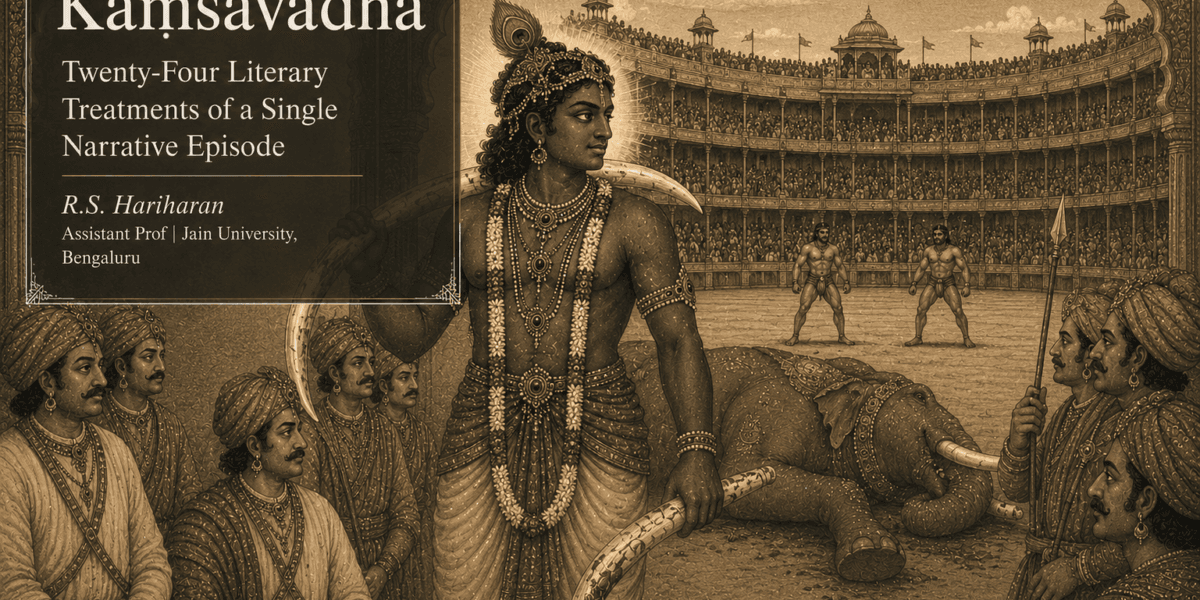

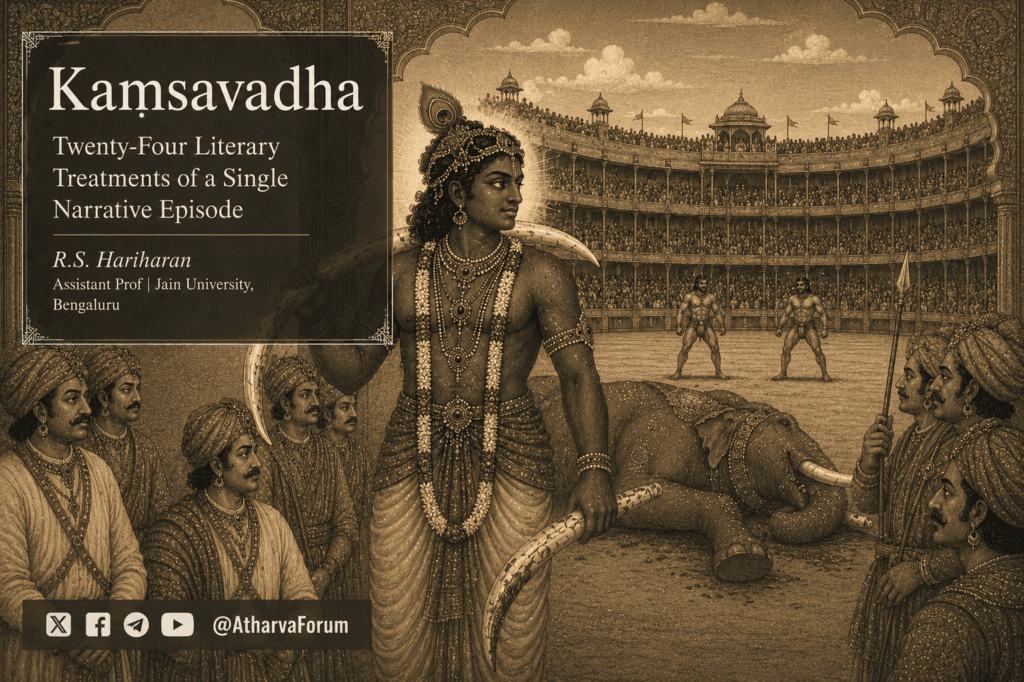
Somewhere in the 5th or 6th century BCE, Pāṇini is said to have written a play called Kaṃsavadha, the slaying of Kaṃsa. It has not survived. A few centuries later Patañjali, in his Mahābhāṣya, mentions actors staging the death of Kaṃsa with their faces painted red and black. By the early 18th century, a Kerala poet named Rāma Pāṇivāda was still returning to the same subject, this time in Prākṛta. Between these two distant points lie at least twenty-four literary treatments of a single episode, spread across drama, epic poetry, prose poetry, mixed prose-and-verse, and Purāṇic narrative.
No other episode in the Sanskrit tradition has drawn poets back to it so persistently, for so long, in so many forms. That fact alone is worth pausing over. The story is not especially long, and its outcome is never in doubt. Kṛṣṇa will kill Kaṃsa. Everyone in the audience knows this before the first verse. So the interest was never in what happens. It was always in how you tell it, and the twenty-four versions are, in effect, twenty-four answers to that question.
The story everyone already knew
The fullest telling sits in the tenth book of the Bhāgavata Purāṇa, which gives the episode 217 verses across six chapters. It is the version against which every later poet was, consciously or not, working.
Kaṃsa, king of Mathurā, has been warned by prophecy that his nephews Kṛṣṇa and Balarāma will be his death. He sends his minister Akrūra to fetch the boys from Gokula on the pretext of a bow-festival. Akrūra goes gladly, because he happens to be a devotee, and the errand is his chance to see the Lord in person.
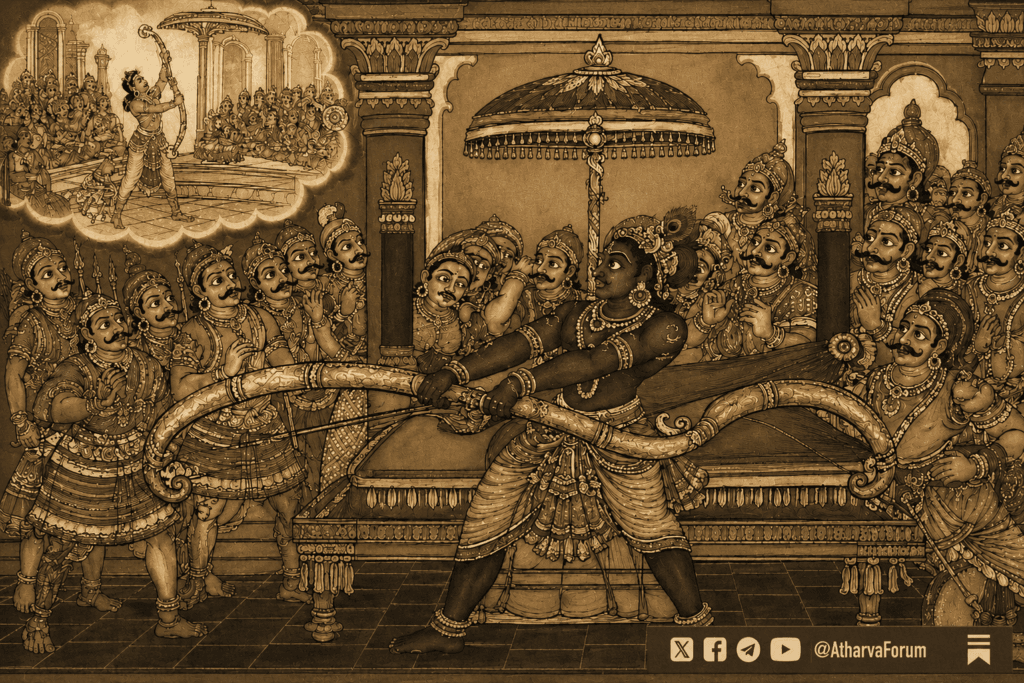
What follows unfolds over three days and about fourteen distinct episodes. On the first day the brothers leave Gokula; the cowherd women follow the chariot in grief, cursing Akrūra for taking Kṛṣṇa away; and at the Yamunā, Akrūra plunges in for his midday prayers and receives a vision of Kṛṣṇa as Viṣṇu, reclining on the cosmic serpent. On the second day the brothers enter the city. They kill an insolent royal washerman, are clothed by a kindly weaver, are garlanded by a florist, and heal a hunchbacked woman named Trivakrā, whom Kṛṣṇa straightens into beauty. Then Kṛṣṇa lifts and snaps Kaṃsa’s ceremonial bow, and the sound of it reaches the king. On the third day comes the war-elephant Kuvalayāpīḍa, the wrestling bouts against Cāṇūra and Muṣṭika, and finally Kaṃsa himself, dragged from his dais by the hair and killed.
That sequence, fourteen episodes across three days, is the grammar. Everything the later poets do is a transformation of it. And when you lay the twenty-four texts side by side, the transformations sort themselves into four recognisable strategies.
Strategy one: Borrowing
The simplest thing a poet can do is keep the structure and pass it on, trimming or expanding only as the form demands. This is not laziness. It is the work of transmission, and it is what keeps a tradition legible across centuries.
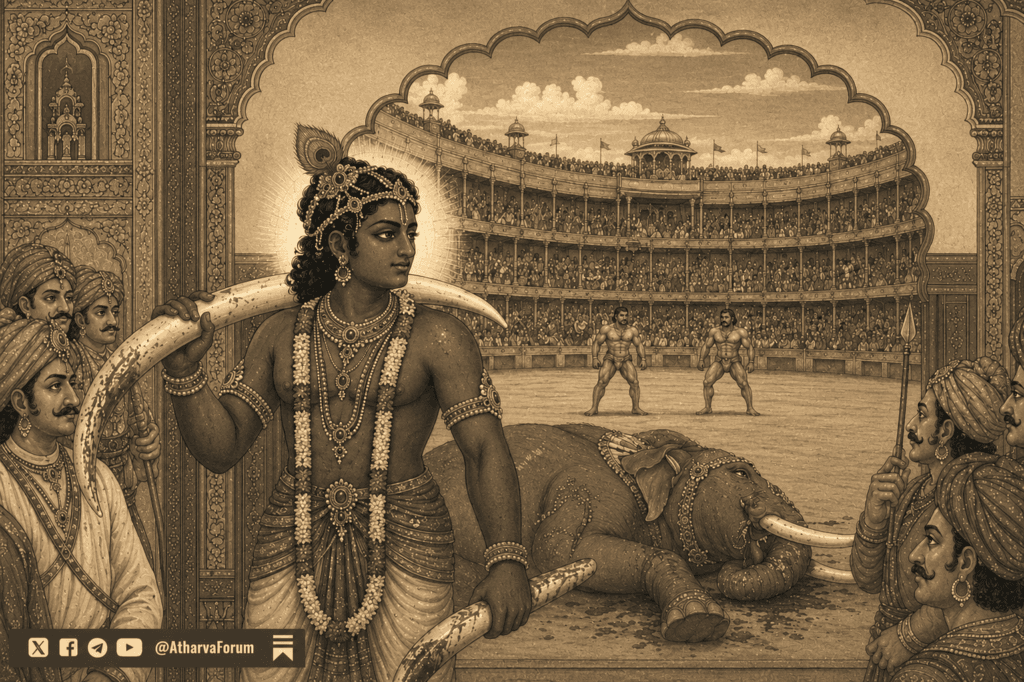
The Viṣṇu Purāṇa compresses the three days into two but keeps the shape intact, and where it differs it does so in small, telling touches. In its wrestling scene, after the elephant is already dead, Balarāma leaps onto the carcass and strikes it again with his left foot in sheer fury:
ततस्तूत्प्लुत्य वेगेन रौहिणेयो महाबलः ।
जघान वामपादेन मस्तके हस्तिनं रुषा ॥
Then the mighty son of Rohiṇī leapt up with speed and struck the elephant on the head with his left foot, in rage.
It is a needless detail, and that is exactly why it matters. Nothing in the plot requires it. The poet simply saw a chance to add a flicker of temper to a character usually played as placid, and took it. This is borrowing at its best: the frame preserved, but never merely copied.
Strategy two: Embellishing
The second strategy keeps the events but lavishes attention on them, letting a single moment swell to many times its original size. This is the natural instinct of the mahākāvya, the ornate court epic, where the point is not the story but the display of poetic skill.
Watch what happens to one small episode, the moment when the healed Kubjā, overcome, invites Kṛṣṇa to her home. In the Bhāgavatam it is a passing beat. In the Garga Saṃhitā, the whole departure from Gokula becomes almost slapstick, the cowherd women physically beating Akrūra’s chariot with sticks until the horses bolt and the charioteer tumbles out. And the bow-breaking, four plain words in the baseline, becomes a set-piece: the bow now weighs a hundred thousand bhāra, needs five thousand men to carry, and was a gift to Kaṃsa from Paraśurāma himself:
यथैन्द्रं हेमचित्राढ्यं कोदण्डं सप्ततालकम् ।
पुरुषैः पञ्चसाहस्रैर् नेतुं योग्यं बृहद्धरम् ॥
Like the bow of Indra, richly adorned with gold, seven palm-trees tall, so immense that five thousand men were needed to carry it.
The event has not changed. Kṛṣṇa still breaks a bow. But the poet has inflated it into spectacle, and in doing so tells us what his audience wanted: not information, but grandeur.
Strategy three: Interpreting
The third strategy is the most intellectually interesting. Here the poet keeps the event but bends its meaning, using the familiar story to make a theological or philosophical point the baseline never intended.
The Bhāgavatacampū of the Andhra poet writing as Abhinava Kālidāsa is the sharpest example. When it comes to Akrūra’s terrifying vision of the Lord, the poet reaches for paradox. Kṛṣṇa, he says, is like a physician who forces disease upon a healthy man, strips him of his wealth, and then announces that the patient will surely die unless he takes refuge in the doctor alone, and for this he is honoured as the greatest of healers. The implication, left hanging, is that this is precisely what the Lord does to the soul: by apparently cruel means he drives it toward liberation.
The same poet defends the pairing of Kṛṣṇa and the hunchbacked Kubjā with a wink, on the grounds that Kṛṣṇa was once the dwarf Vāmana, so the two are simply well matched, both being bent in form. What in the Bhāgavatam is a miracle of healing becomes, here, an occasion for wit and doctrine at once. The event is untouched; its significance has been entirely rewritten.
The Brahma Vaivarta Purāṇa interprets in a different key, turning the Kubjā episode into a full theology of rebirth: she was Śūrpaṇakhā in a previous life, performed austerities for Kṛṣṇa when he was Rāma, and now receives her reward. The death of Kaṃsa, too, is transfigured, the tyrant sees the whole universe as Kṛṣṇa, ascends in a jewelled vehicle, and his radiance dissolves into the Lord’s feet. Even the villain is saved. The plot has not moved an inch, but its whole moral universe has shifted.
Strategy four: Refashioning
The fourth and boldest strategy breaks the frame itself, reordering, cutting, or rebuilding the episode until it belongs to a new form altogether.
Drama forces this. Bhāsa’s Bālacarita, almost certainly the oldest surviving treatment outside the Purāṇas, cannot stage a war-elephant or a wrestling match, so it does not try. Instead the killings are reported by witnesses, and the whole action is built around a single spoken vow. Early in the fourth act, Kṛṣṇa promises:
आकृष्य कंसमहमद्य दृढं निहन्मि नागं मृगेन्द्र इव पूर्वकृतावलेपम् ॥
Dragging Kaṃsa down, I shall today slay him as a lion slays an elephant that once was arrogant.
The vow is spoken in the fourth act and fulfilled, offstage and by report, in the fifth. The poet has taken the sprawling three-day chronicle and refashioned it into the tight architecture of vow and consequence that drama demands.
Others refashion by radical compression. The Devī Bhāgavata Purāṇa, whose loyalties lie with the Goddess rather than with Kṛṣṇa, disposes of the entire Kaṃsavadha in three verses, dropping the lament, the vision, the washerman, the florist, Kubjā, and the bow-breaking without ceremony. The constraint-driven forms do the same in their own way: the Nārāyaṇīyam must fit each episode into a ten-verse block, and the Śaurikathodayaḥ binds itself to elaborate sound-play that leaves little room for narrative at all. In every case the poet has decided that fidelity to a new form matters more than fidelity to the old sequence.
What the verse-counts reveal
Here is the most useful single tool for reading the whole tradition, and it is almost embarrassingly simple: count the verses each poet gives to each episode, and you can see, without any guesswork, what that poet actually cared about.
The numbers speak plainly. The cowherd women’s lament runs to four verses in the Bhāgavatam, nineteen in the Viṣṇu Purāṇa, and thirty-eight in Vedānta Deśika’s Yādavābhyudayam, where the theme of separation clearly mattered most. Akrūra’s vision, fifty-five verses at the source, shrinks to a single verse in Rāma Pāṇivāda’s Prākṛta poem and vanishes entirely from Sukumāra Kavi’s Śrīkṛṣṇavilāsam, the only text in the whole corpus to omit it. A poet who spends thirty-eight verses on grief and four on a theophany is telling you exactly where his heart lies, and he is telling you in a form you can measure.
This is why the four strategies are visible arithmetic beyond just labels. Borrowing shows up as proportions roughly faithful to the baseline; embellishing, as one episode ballooning far past its source; interpreting, as verses spent on commentary and simile rather than action; refashioning, as whole episodes cut to nothing or the running order overturned. The distribution of verses is the fingerprint of the poet’s intent.
Why it kept happening
It is worth asking, finally, why this particular episode drew poets back for two thousand years when its ending was never in doubt.
Part of the answer is that the story is unusually generous. It offers physical spectacle in the elephant and the wrestling; devotional depth in Akrūra’s vision and the healing of Kubjā; a natural three-day arc; and a whole cast of minor figures, the arrogant washerman, the devoted florist, the lovesick hunchback, each of whom a poet may keep, cut, or expand at will. It is, in other words, a story with many handles.
But the deeper answer is that a fixed ending is not a limitation for these poets. It is a kind of liberation. Precisely because no one needed to be told what happens, the poet was free to spend all his art on how, and on what it means. A Kerala muralist and a Kashmiri anthologist and an Andhra wit could each take the same three days from Gokula to Mathurā and make something unmistakably their own. The death of Kaṃsa was never really the subject. It was an occasion. And for two thousand years, that occasion was enough.
______________________________________________________________________________________________
Based on three research papers by R. S. Hariharan and Shankar Rajaraman, published in Shodhsamhita (Vol. XI, Issue 2, 2024), Mahāsvinī (NSU-365, Vol. II, Aug–Dec 2024), and the Quarterly Journal of the Mythic Society (Vol. 116, No. 2, April–June 2025).

No Comment! Be the first one.